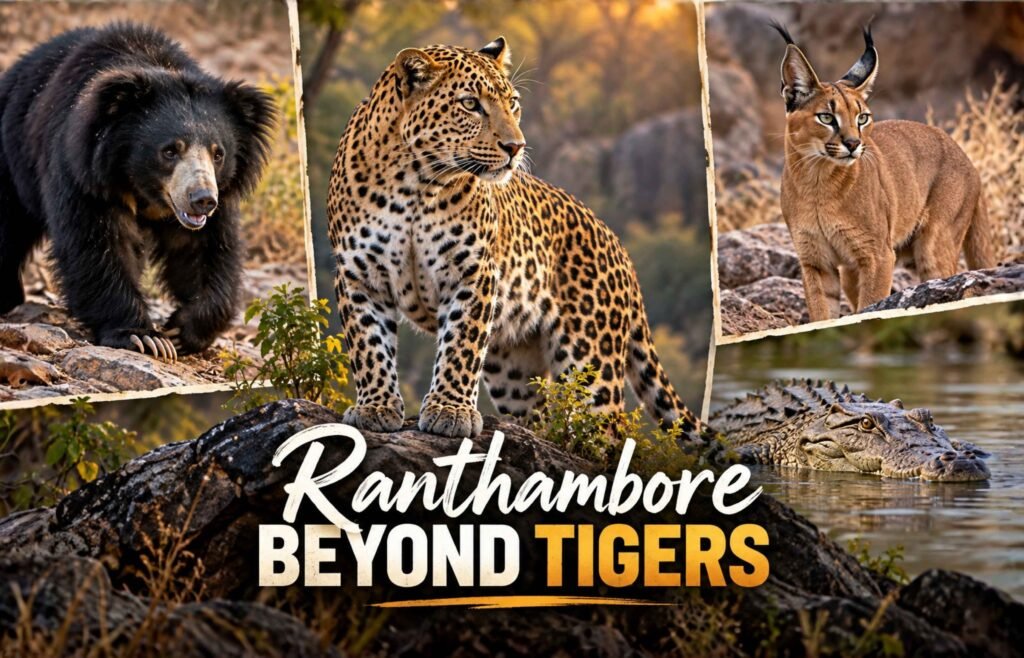
Ranthambore Beyond Tigers: 7 Rare Wildlife Species You Might Spot on Safari
Most people come to Ranthambore for one reason: the tiger. And it is easy to see why. But ask any experienced guide, and they will tell you that some of their most unforgettable sightings had nothing to do with tigers.
Ranthambore’s mix of dry forest, rocky hills, grasslands and lakes supports a surprising variety of wildlife. Some animals are seen on almost every drive. Others are so shy or nocturnal that a single sighting becomes a story you tell for years.
Here are 7 rare and special wildlife species you might spot on a Ranthambore safari, and what makes each of them remarkable.
Planning a safari? Our local team in Sawai Madhopur can help you book the right slots and zones for your dates.
[Check Safari Availability on WhatsApp]
1. Leopard: The Shadow in Tiger Country
Ranthambore has a healthy leopard population, but seeing one is far harder than seeing a tiger. Leopards here live in the shadow of a much stronger cat, so they avoid tigers by keeping to rocky hills, cliffs and the edges of the forest.
A leopard is smaller and more slender than a tiger, with rosette-shaped spots instead of stripes. It is a superb climber and often rests on rocks or in trees.
Where to look: rocky ridges, old ruins and the hilly parts of the park, especially early in the morning.
2. Sloth Bear: The Shaggy Termite Hunter
With its shaggy black coat, pale snout and white V-mark on the chest, the sloth bear is one of Ranthambore’s most exciting sightings. It feeds mainly on termites, ants and fruit, and can suck up insects from a termite mound with its lips and long snout. Mothers carry their cubs on their backs.
Don’t be fooled by its comical look. Sloth bears are known to be bad-tempered when surprised, and are considered one of the more dangerous animals to run into on foot. It is listed as Vulnerable by the IUCN.
Where to look: hilly, rocky areas and around termite mounds and fruiting trees.
3. Striped Hyena: The Night Scavenger
The striped hyena is a shy, mostly nocturnal animal with a sloping back, striped body and a mane that it raises when threatened. It is a scavenger, cleaning up carcasses and crushing bones with its powerful jaws.
Daytime sightings are rare, which makes them special. The striped hyena is listed as Near Threatened by the IUCN.
Where to look: early morning and late afternoon drives, along open tracks and the edges of the forest.
4. Caracal: Ranthambore's Rarest Cat
The caracal is a medium-sized wild cat with a sandy coat and long black ear tufts. It is famous for its powerful leaps, and can jump into the air to swat birds in flight.
In India, the caracal has become extremely rare, and Ranthambore and its surrounding landscape are among the few places where it is still reported. A caracal sighting is a once-in-a-lifetime moment, even for people who visit the park for years.
Where to look: there is no reliable spot. Sightings are pure luck, usually in drier, scrubby areas.
5. Honey Badger: The Fearless Little Fighter
The honey badger, or ratel, is a low, stocky animal with a black body and a broad silver-grey back. It may be small, but it has a reputation as one of the most fearless animals in the world, willing to stand up to animals many times its size.
It is mostly nocturnal and very secretive, so most people only ever see it in camera trap photos. Spotting one on a daytime safari is a real stroke of luck.
Where to look: mostly at dawn and dusk, along quiet edges of the forest.
6. Rusty-Spotted Cat: One of the World's Smallest Wild Cats
The rusty-spotted cat is one of the smallest wild cats on Earth, smaller than most house cats. It has a soft greyish coat dotted with rust-coloured spots and large eyes suited to hunting at night.
Because it is so small, shy and nocturnal, very few visitors ever see one. For wildlife enthusiasts, it is one of the hardest animals to tick off in all of India.
Where to look: practically impossible to plan for. Keep your eyes open around dense undergrowth at the start and end of a drive.
7. Mugger Crocodile: The Ancient Guardian of the Lakes
The mugger, or marsh crocodile, is the easiest animal on this list to see, but no less special. Ranthambore’s lakes, such as Padam Talao, Rajbagh and Malik Talao, are home to muggers that bask on the banks on sunny mornings.
Muggers are powerful predators that can take deer coming to drink. They are listed as Vulnerable by the IUCN.
Where to look: lake edges on sunny winter mornings, when they come out to warm up.
How Rare Are They? A Quick Sighting Guide
| Species | How often seen | Best time |
|---|---|---|
| Mugger crocodile | Common | Sunny mornings near lakes |
| Sloth bear | Occasional | Mornings, hilly zones |
| Leopard | Occasional to rare | Early mornings, rocky areas |
| Striped hyena | Rare | Early morning, late afternoon |
| Honey badger | Very rare | Dawn and dusk |
| Caracal | Extremely rare | Pure luck |
| Rusty-spotted cat | Extremely rare | Pure luck |
How to Improve Your Chances of Seeing Rare Ranthambore Wildlife
- Book more than one safari. Every drive covers a different stretch of forest, so more drives mean more chances.
- Mix morning and afternoon slots. Shy and nocturnal animals are most active around dawn and dusk.
- Try different zones. Rocky, hilly zones suit leopards and sloth bears, while lake areas are best for crocodiles and birds. The outer Zones 6 to 10 are often quieter.
- Choose a Gypsy. A smaller, quieter vehicle is less likely to disturb shy animals than a crowded Canter.
- Tell your guide what you want to see. Experienced guides know where rarer animals have been seen recently.
- Stay quiet and patient. Most rare sightings happen to people who wait.
Want to see more than tigers? We can plan a multi-safari trip across different zones and slots to give you the best chance at Ranthambore’s rarer wildlife. 👉 [Plan My Ranthambore Safari] · 📖 [Ranthambore Safari Booking Guide 2026-27]
Conclusion: Come for the Tiger, Remember the Rest
A tiger sighting is the dream of every Ranthambore visitor. But the forest has far more to offer: a leopard melting into the rocks, a sloth bear digging into a termite mound, or a caracal that you will talk about for the rest of your life. Keep your eyes open beyond the stripes, and Ranthambore will surprise you.
Which of these animals would you most like to see? Tell us in the comments.
Frequently Asked Questions (FAQ)
What animals can you see in Ranthambore besides tigers? Ranthambore is home to leopards, sloth bears, striped hyenas, mugger crocodiles, sambar, chital, nilgai, langurs and many birds, along with rare species like the caracal, honey badger and rusty-spotted cat.
Can you see a leopard in Ranthambore? Yes, but it is less common than seeing a tiger. Leopards avoid tigers by staying in rocky, hilly areas, so early-morning drives in such zones give the best chance.
Are there caracals in Ranthambore? Yes. Ranthambore and its surrounding landscape are among the few places in India where caracals are still reported, but sightings are extremely rare.
Are sloth bears dangerous? Sloth bears can be aggressive when surprised at close range, especially mothers with cubs. On a safari, you watch them safely from your vehicle.
What is the best way to see rare wildlife in Ranthambore? Book several safaris across different zones and time slots, choose a Gypsy, and ask your guide about recent sightings.